Best MERV Rating for 17x22x4 Air Filters: 8, 11, or 13
A 17x22x4 air filter is a 4-inch-deep pleated HVAC filter that sits in a media cabinet rather than the thin 1-inch slot most homes have. Because the cabinet is built for depth, the usual trade-off between cleaner air and strained airflow mostly disappears. The question is whether your household needs MERV 13, not whether your system can take it.
TL;DR
In a 17x22x4 cabinet, MERV 13 is usually the right choice. Four inches of depth gives the filter enough media surface area to run a high rating without choking airflow, and DOE data shows a 4-inch filter can offer less resistance than a 1-inch filter at the same MERV. Step down to 11 or 8 only if your system already runs high static pressure or your manufacturer caps filter efficiency.
Key Takeaways
MERV 13 captures more than 50% of particles in the 0.3–1.0 micron band, which includes smoke and bacteria. MERV 11 captures over 20%; MERV 8 is not rated there at all.
The EPA recommends at least MERV 13 for home systems, or the highest rating your fan and filter slot allow.
Depth, not rating, drives airflow resistance. In DOE data, a 4-inch MERV 7 filter measured 0.12 in. w.c. against 0.20 for a 1-inch filter of the same rating.
Seal quality can outweigh rating. ASHRAE states a lower-efficiency filter may perform better if better sealed.
What Is A 17x22x4 Air Filter, And What Size Is It Really?
A 17x22x4 is a nominal size. The actual filter measures 16.5 by 21.5 by 3.63 inches, because the label rounds up so it slides in without binding. A filter undersized by half an inch lets unfiltered air bypass the media through the gap.
Filterbuy, a U.S. manufacturer producing pleated HVAC filters in more than 600 sizes, publishes the actual dimensions and available ratings for this size and makes it in MERV 8, 1,1 and 13. If you do not know your nominal size, measure the filter or the cabinet opening and round each dimension up to the nearest inch.
What Do MERV 8, 11, And 13 Actually Filter?
MERV is a 1–16 scale set by ANSI/ASHRAE Standard 52.2, reporting capture across three particle bins: 0.3–1.0 micron (E1), 1.0–3.0 (E2), 3.0–10 (E3).
Source: DOE Building America Solution Center, from NAFA (2017) and EPA (2009).
The decisive gap is E1. MERV 8 carries no minimum requirement for particles between 0.3 and 1.0 micron, the range containing wildfire smoke, cooking particulate, and bacteria. MERV 13 must capture over half.
MPR and FPR on packaging are proprietary to 3M and Home Depot; MERV is the consensus standard. Roughly: MERV 8 ≈ FPR 4–7 or MPR 600–1000, MERV 11 ≈ FPR 6–9 or MPR 1200–1550, MERV 13 ≈ FPR 10 or MPR 1900–2800.
Does A Higher MERV In A 4-Inch Filter Restrict Airflow?
Usually not enough to matter, and this is where most filter advice goes wrong. DOE states that pressure drop can be greatly reduced by filter design, independent of MERV rating: deeper, more numerous pleats mean more media area, so the same air passes through at lower velocity. A 4-inch pleat pack carries roughly twice the media area of a 2-inch one.
DOE published resistance for three filters of identical MERV 7 rating at 300 FPM:
Depth cut resistance by 40% at the same rating. That headroom is what a 17x22x4 cabinet buys you.
One caveat: the filter is only 20% to 50% of total system pressure drop, so a marginal duct system stays marginal whatever you put in it.
Why A Sealed MERV 11 Can Beat A Leaky MERV 13
The rating on the frame is a laboratory number. What your house gets depends on whether air is forced through the media or slips around it, and ASHRAE puts it plainly: "A lower efficiency filter may give better performance if the seal is better."
This matters more in a 4-inch cabinet than a 1-inch slot, because a media cabinet is a box with a door, gasket, and latches: three more failure points. Check for a hardened or missing gasket, latches that no longer pull the door flush, and daylight around the frame with a flashlight behind it. Fix the seal before buying a higher rating.
How Do You Match The MERV Rating To Your Household?
Start at MERV 13 and justify stepping down. In a 4-inch cabinet, the cost difference is modest and the airflow penalty small, so the burden of proof belongs on the lower rating.
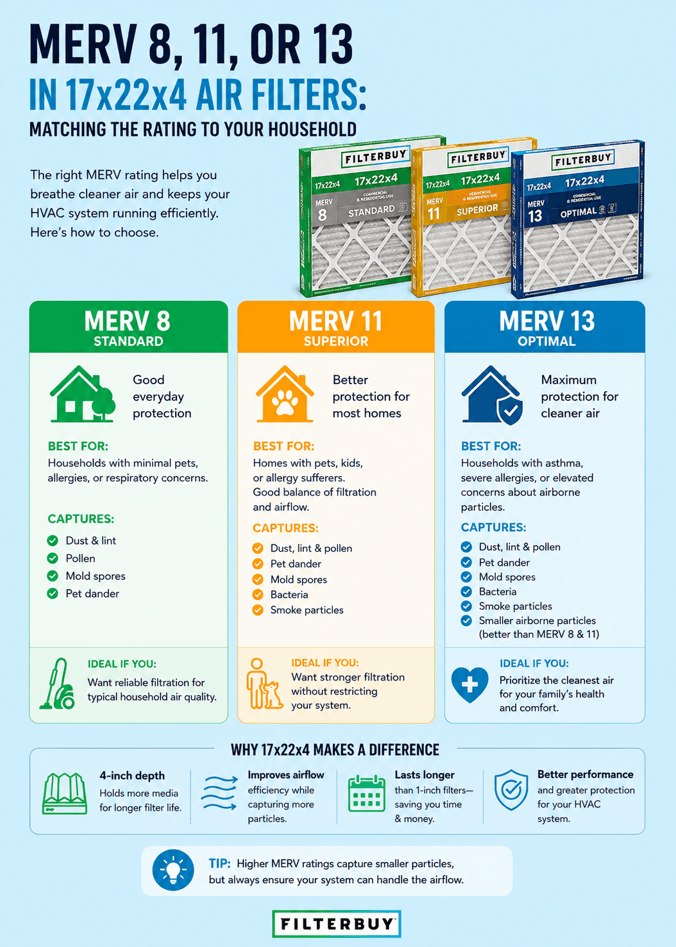
Choose MERV 13 if anyone has asthma, COPD, or year-round allergies; wildfire smoke or traffic is a seasonal reality; you have multiple pets or an immunocompromised household member; or your system uses an ECM blower with sealed, correctly sized ducts.
Choose MERV 11 if you want real allergen control but run a PSC blower already near 0.4 in. w.c. It is a genuine step up from MERV 8 in the 1.0–3.0 micron band, 65% against 20%, while asking less of the blower.
Choose MERV 8 if your manufacturer caps filter efficiency, your ductwork is undersized, or the filter's job is equipment protection. It is a real filter, not a lint screen, but it will not address fine particulate. If so, the standard-efficiency version of this size is the one to consider.
Before upgrading, read the frame label. Since April 2019, California has required MERV rating, particle-size efficiency, and pressure drop printed there, which is often the only pressure figure a homeowner can get.
How Often Should You Change A 17x22x4 Filter?
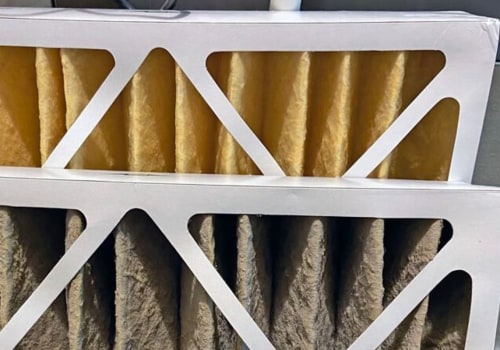
Inspect at 30 days, replace at 90, and push to 120 only if the filter comes out visibly clean. Shorten that for pets, allergies, indoor smoking, four or more occupants, or nearby construction.
Published intervals disagree, sometimes on one page: Filterbuy's own 17x22x4 listing carries a 3-month badge, a 6-to-9-month line, and a 12-month specification. Those are three true answers to different questions.
Replace immediately, whatever the calendar says, if pleats have collapsed, the system bangs on startup, or the media is damp. Excessive resistance can overheat a furnace.
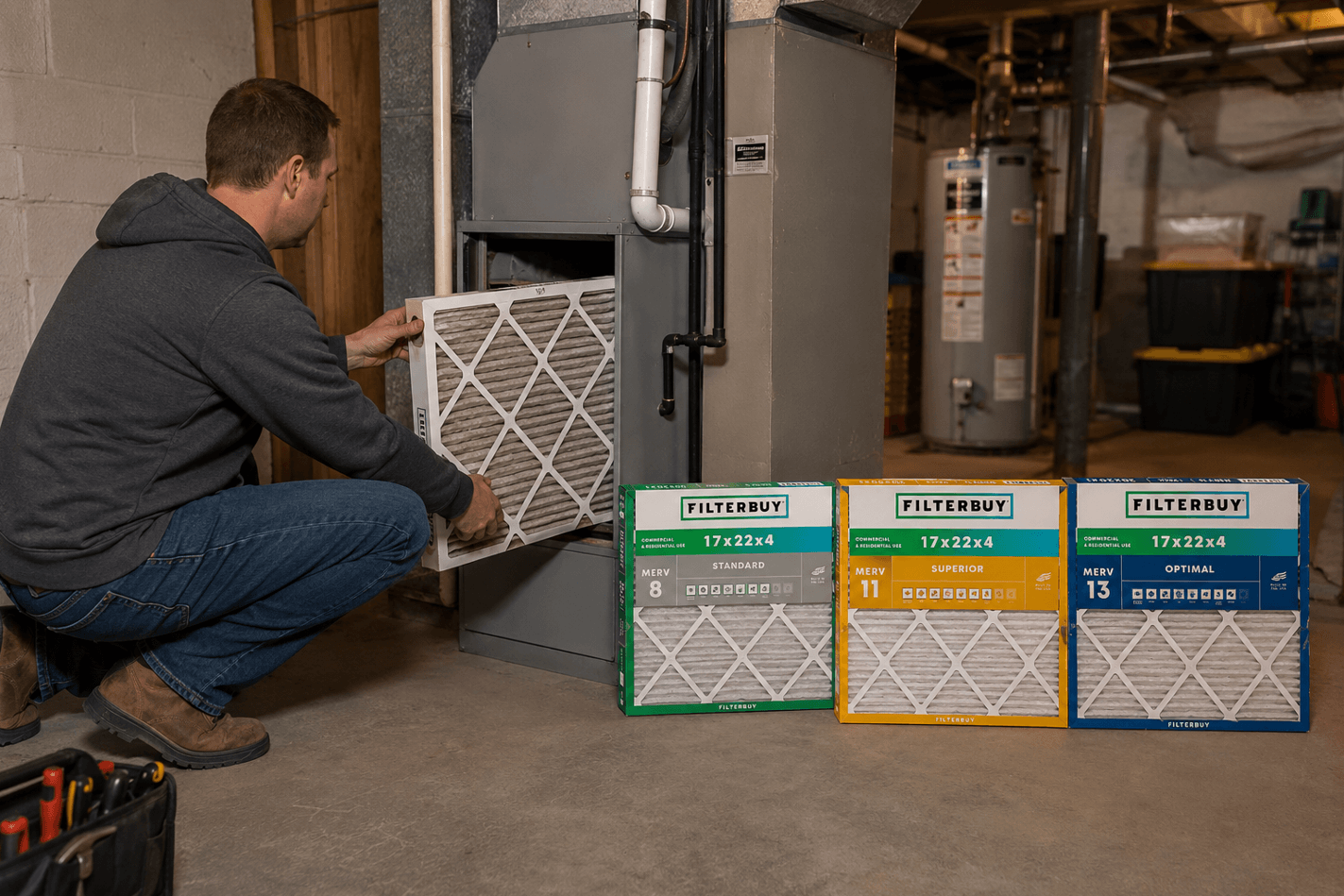
"After a decade of shipping 4-inch filters into homes across the country, the problem we see most often isn't a system that can't handle MERV 13. It's a homeowner who assumed it couldn't and put MERV 8 in a cabinet built to do far more. When the depth is already there, the filtration headroom is already paid for."
-The Filterbuy Team
Essential Resources On 17x22x4 Air Filters
1. Confirm The Size And Available Ratings
Verify actual dimensions and available ratings before ordering a case.
Source: Filterbuy’s 17x22x4 Air Filters
2. Get The Federal Recommendation On Which MERV To Buy
The plainest federal answer on how high to go, and where furnace filters fit alongside portable air cleaners.
Source: Guide To Air Cleaners In The Home, U.S. EPA
3. Understand Why Depth Beats Rating
The DOE guide behind the pressure-drop figures above, covering static pressure, blower types, and the surface-area maths behind a 4-inch cabinet.
Source: High-MERV Filters, DOE Building America Solution Center
4. Get Independent Health Guidance On Filter Choice
The American Lung Association recommends upgrading furnace filters to MERV 13 or above, and gives a low-tech test for a spent air filter: hold it against a white sheet of paper.
Source: Air Cleaning, American Lung Association
Supporting Statistics
1. High-Efficiency Central Filtration Cuts Indoor Fine Particles By About Half
A randomized, sham-controlled crossover study of California homes found upgraded central HVAC filtration cut indoor PM2.5 by roughly 50%, and particles of outdoor origin by roughly 77%.
2. About 6.5% Of U.S. Children Currently Have Asthma
CDC puts current asthma at 6.5% of children and 8.6% of adults as of 2024, about one child in fifteen. Those households need the E1 band MERV 8 does not cover.
Source: FastStats: Asthma, Centers for Disease Control and Prevention
3. Dust Mite Allergy Affects 20 Million People In The U.S.
The Asthma and Allergy Foundation of America counts 20 million dust mite sufferers within more than 106 million people who experience allergies of some kind each year, about one in three. Dust mite debris is coarse enough that MERV 8 already controls it, so the reason an allergy household steps up to MERV 11 or 13 is everything finer that MERV 8 misses.
Source: Allergy Facts And Figures, Asthma and Allergy Foundation of America
Final Thoughts
The warning to be careful above MERV 8 was written for 1-inch slots, then repeated until it hardened into a general rule. A 17x22x4 cabinet is a better housing than that rule assumes.
Defaulting to MERV 8 in a 4-inch cabinet is the most common waste in residential filtration: you paid for the depth, and the depth is what makes MERV 13 practical. The real constraint is rarely the filter. It is undersized returns, unsealed joints, or a system already at 0.5 in. w.c., and a cheaper filter hides those problems instead of fixing them.
Next Steps
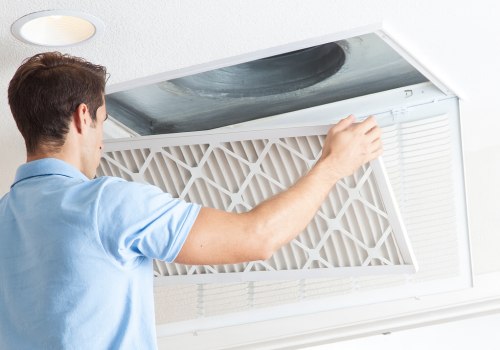
Pull the current filter and read the frame for size, MERV rating, and any pressure-drop figure, then confirm 16.5 x 21.5 x 3.63 inches fits your cabinet with no gap.
Check your air handler documentation for a filter resistance or efficiency cap. If one exists, it overrides everything else.
Measure total static pressure with a manometer, return plus supply side. At or below 0.4–0.5 in. w.c. means you have room to upgrade. Write the install date on the frame and set a 90-day reminder.
Above 0.5, add a filter area rather than dropping the rating. DOE's remedy is to size the return per ACCA Manual D and, where space allows, fit two filters side by side.
Frequently Asked Questions
Q: Can I Put A MERV 13 Filter In A 17x22x4 Cabinet?
A: In most cases, yes, and in a 4-inch cabinet it is the default to start from. Confirm your manufacturer does not cap filter efficiency and that measured static pressure sits at or below 0.4–0.5 in. w.c.
Q: Is A 17x22x4 The Same As A 16.5x21.5x3.63?
A: Yes. 17x22x4 is the nominal size on the label; 16.5 x 21.5 x 3.63 inches is the actual measurement. Order by nominal; verify actual against your cabinet opening.
Q: Does MERV 13 Raise My Energy Bill?
A: Not meaningfully in a 4-inch cabinet with correctly sized ducts. A clean MERV 13 costs less to run than a loaded MERV 8; DOE puts the clean-versus-clogged difference at 5% to 15%.
Q: My Filter Rattles In Its Cabinet. Does That Matter?
A: Yes. A filter loose enough to rattle lets air around it, and that air skips filtration entirely. Check the gasket and latches before paying for a higher rating.
Get The Right Rating Into Your 17x22x4 Cabinet
You already own the housing that makes high-efficiency filtration practical, so the only decision left is which rating your household needs. Measure your static pressure, check your manufacturer's limit, and order the MERV that matches.
Learn more about HVAC Care from one of our HVAC solutions branches…
Filterbuy HVAC Solutions - West Palm Beach FL
1655 Palm Beach Lakes Blvd., Ste 1005 West Palm Beach, FL 33401
(561) 448-3760
https://maps.app.goo.gl/VarpgNZnxuPQuW8A7